 February 1, 2026
  Admin
Admin 
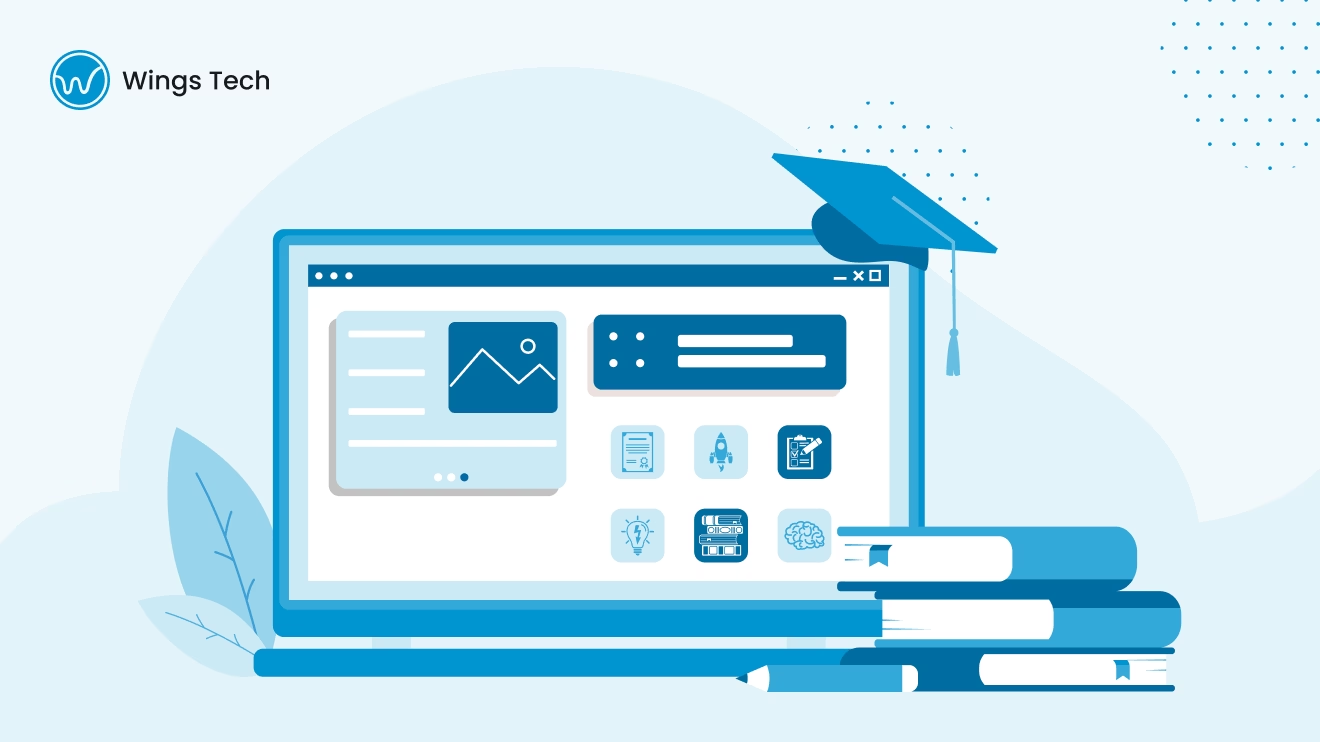
Table of Contents
Your college lecture might happen while you’re commuting, and your personal tutor could be an algorithm that never forgets where you struggled yesterday. This is the transformation that EdTech website development has achieved completely changing how knowledge transitions from instructor to learner. EdTech platforms are not merely digitized classrooms; they integrate pedagogy, technology, and engagement to create learning experiences that truly resonate.
In education technology, poor user experiences don’t get second chances. With the global EdTech market racing toward $404B by 2026, learners now expect flawless experiences and platforms that don’t crash during finals week. This guide walks you through building an EdTech website that’s part university campus, part study buddy, and part career accelerator all accessible from any device.
What is EdTech Website Development?
Look past the surface, and EdTech website development is about engineering platforms where learning happens digitally. Consider online courses, virtual classrooms, learning management systems, tutoring marketplaces, skill assessment tools, and educational games. However, beneath the video players and quiz interfaces, the real effort lies in building learning
ecosystems that students trust and teachers can effectively use.
From a technical standpoint, these platforms juggle content delivery systems, user progress tracking, real-time collaboration tools, and assessment engines. These websites don’t just display lessons, they map learning journeys, remember where each student left off, and adapt content based on performance. Every click in EdTech carries weight, with
users constantly judging whether your platform helps them learn or wastes their time.
Building a Strong Online Presence for your EdTech Company
With the advent of coding bootcamps and platforms such as YouTube offering unlimited access to knowledge and learning, your EdTech platform must be clear about the value it provides for its users. Below we will discuss how the world of education is evolving thanks to EdTech.
Democratizes Access to High-Quality Education
The ability to learn should not be determined based on your location or how much money you earn. The Internet allows anyone access to quality education, as long as they have access to a well-built online educational platform. Students living in rural areas have the same content available to them as urban students. Students with disabilities have access to all of the built-in accommodations offered by the EdTech platform. Working parents can continue their education at night after their children go to bed.
Adapts to Individual Learning Curves
The majority of students are not successful with cookie-cutter education. Your platform can monitor a learner’s speed of concept acquisition, which subjects require reinforcement, and which teaching strategies work best for them. Smart EdTech provides precisely what each person needs to succeed, whether they require more visual aids or practice problems.
Personalization Of Learning For Every Student
Most students do not find success in cookie-cutter education systems. Your EdTech platform can monitor how fast each learner picks up concepts; what areas need additional support; and which teaching methods work best. Intelligent EdTech provides students with exactly what they need in order to be successful, whether they need to see more visual aids or do more practice problems.
The EdTech Website Development Journey
Building a learning platform that earns trust follows these critical phases:
Research & Strategy Phase
Your EdTech project begins by understanding your students. What are they doing wrong to prevent successful learning for now? What would make your students select your learning system instead of free video lectures on YouTube? Avoid general surveys. Identify your distinct manner of teaching. It continues here.
Design & Prototyping Phase
EdTech design is the intersection between Learning Theory and Pixels and the design created through wireframes and prototypes is ultimately what students will experience when they are in the learning environment. As such, these designs should be functional across different devices (e.g., laptop, tablet, and mobile phone). Quality Educational Design is “transparent” to the students, allowing them to focus on learning (e.g., Calculus) rather than searching for where to click to “submit” an assignment or project.
Building & Integration Phase
The Interface that students will utilise to navigate through the various modules, and all of the associated functionalities is created by the Front-End. The Back-End System manages and maintains Users, User Accounts, Content Libraries, Calculation of Grades, Live Streamed Events and the Integration of the Video Hosting System and Payment Processing System. All Video Hosting and Payment Processing Systems Integration are done carefully to ensure that everything functions properly.
Quality Assurance & Testing Phase
To simulate the hectic environment of a classroom, we’ve begun testing an EdTech platform. For example, we want to determine if video playback can work on an iPad that is three years old. How does the EdTech platform perform when 200 students submit a test at the same time? How can a learner recover their essay if their web browser crashes? We are currently conducting accessibility testing, security assessments and stress testing. Breaking things in a test is preferable to doing so during a student’s final exam.
Technology Stack for EdTech Platforms
Frontend Frameworks
These technologies are what learners see and use every day:
React.js:The best technology for creating interactive learning dashboards and allowing learners to collaborate in real-time. Its component-based architecture allows you to easily create reusable components such as quiz widgets, progress bars, and video players that can be used consistently across your platform.
Vue.js: A lightweight and easy-to-use technology that is perfect for fast-moving EdTech startups. Smaller teams developing targeted learning products often prefer Vue’s simple designing capabilities.
Interactive Elements: Smooth animations and micro-interactions help direct learners through content, provide immediate feedback and create an interface that is responsive rather than static.
Backend Systems
The core functionality of your education technology is supported by:
Node.js: gives you the ability to add real-time features like live video chat in classrooms and collaborative drawing/white boarding, as well as being able to handle multiple user connections simultaneously;
Python with Django: Python supports creating sophisticated content-driven platforms with artificial intelligence capabilities, which allows you to build sophisticated learning systems that adapt to the learning journey (as well as being used for adaptive-based learning systems)
Ruby on Rails: Has a faster development cycle than PHP and can create prototypes for quick releases, while maintaining clean, scalable code
PHP with Laravel: powers many of the educational platforms used today particularly those that need to connect to existing institutional software or those developed using a modular hybrid stack.
Database Solutions
Reliable databases are essential to store all the student records, course information, and progress-tracking capabilities of educational technology platforms.
The Necessary Components for Your Educational Technology Solution
Your education platform should contain useful tools for learning and not be overly complex:
Learning Manager for Students
A well-structured dashboard is the first place where every student can access their current status in a particular course, where to find your future assignments, a summary of your recent grades, and a list of suggested courses based on prior performance.
Course Creation Tools
Instructors need dead-simple ways to build courses, upload materials, and organize content. Drag-and-drop course builders, bulk content uploads, and template systems make course creation accessible even for non-technical teachers. Version control lets instructors improve courses without breaking them.
Virtual Classroom
Real-time video conferencing, screen sharing, interactive whiteboards, polls, and breakout rooms recreate classroom dynamics online. Recording functionality lets absent students catch up, and chat transcripts become study materials.
Investment in Development of an EdTech Platform
EdTech platform costs vary significantly based on features and scale:
Starter platforms There are several different types of EdTech Platforms available today that range in price from $10k – $25K depending on the features that you would like your platform to include and how extensive you want it to be.
Starter platforms include everything necessary for a single instructor (or small tutor), or a way to test an instructional concept without substantial costs associated with creating a complete EdTech Platform.
Professional platforms featuring live classes, interactive assessments, progress analytics, mobile apps, and third-party integrations typically cost $50,000 to $150,000. These suit growing education businesses, corporate training departments, and mid-sized institutions.
Learning ecosystems in Enterprises with AI-enhanced personalized, Advanced Analytics, Custom Integrations, White Label Options and Multi-Tenant Architecture Range from $200,000 to over $750,000. Colleges, major training organisations, and fast-growing education technology companies are doing business in this area.
EdTech Development Partners | Collaborating with Wings Tech
Wings Tech partners with schools, educators, and entrepreneurs to help develop innovative technology platforms for education. Our goal for EdTech platform development is rooted in the belief that when technology ceases to exist and the focus of the educational process is returned to learning, we will have reached our goal of achieving success in the development of our EdTech platform. Wings Tech Co-Founders Have Extensive Experience Designing User-Friendly Interfaces For Students, Engineering Scalable Systems, And Creating Accessible Platforms To Meet The Needs Of A Wide Variety Of Learners.
The Insightful Logic of Using Wings Tech for Your EdTech Development
The design and development of exceptional online educational technology platforms requires an understanding of sophisticated engineering and learning design principles. At Wings Tech, we’ve guided educators and entrepreneurs through the complexities of accessibility requirements, scalable architecture, and engagement mechanics. We’ve learned what drives student success and what causes platforms to fail. Let’s collaborate to build an EdTech website that makes quality education more accessible, engaging, and effective for learners everywhere.